If you're choosing between Gemini 4 Hydrogen and Carbon, here's the short answer: Hydrogen costs $1.50 per million input tokens and $7.50 per million output tokens. Carbon costs $2 and $10 right now, then doubles to $4 and $20 on December 1, 2026. After that date, Hydrogen costs 62.5% less than Carbon on every token type.
Google released three Gemini 4 models in quick succession this autumn. Gemini 4 Argon came first. Gemini 4 Carbon became generally available on November 10, 2026. Gemini 4 Hydrogen followed on November 12.
This guide compares Hydrogen and Carbon on price. It covers how each token type is billed and what Carbon's price increase does to a monthly bill. It also runs three realistic workloads through both models, so you can see the difference in dollars.
What are Gemini 4 Hydrogen and Carbon?
Carbon is Google's frontier model for hard problems that need deep reasoning. Hydrogen is the fast model for everyday agentic work. Google designed them to work together.
Gemini 4 Carbon (gemini-4-carbon) targets complex, long-horizon tasks. These include multi-package code migrations, root-cause analysis across subsystems, and dense document analysis. Google says it ranks first on CursorBench 4.0 and Zapier's AutomationBench. Google also notes that Carbon uses more tokens than Argon to reason and verify its work. That matters for cost.
Gemini 4 Hydrogen (gemini-4-hydrogen) is what Google calls its "daily driver for agentic workflows." Google says it finishes tasks 2.5 times faster than Gemini 3.8 Flash. It scores 51 on the Artificial Analysis Intelligence Index, one point above Argon. Its context window is 1 million tokens. Developers can choose from four thinking levels.
The two models are often paired. In Google Antigravity's Orchestrator, Carbon plans while Hydrogen handles worker and verifier tasks. Google reports that this setup came close to Carbon's own task success on Terminal-Bench 4.0. It used 24% less quota and finished 19% faster.
Both models are available through the Gemini API in Google AI Studio and through Gemini for business. Only Hydrogen has a free tier; Carbon requires a paid tier.
API pricing comparison
Hydrogen is 25% cheaper than Carbon until November 30, and 62.5% cheaper from December 1. All prices below are in USD per million tokens on the Standard tier.
| Token Type | Hydrogen | Carbon (to Nov 30, 2026) | Carbon (from Dec 1, 2026) |
|---|---|---|---|
| Input | $1.50 | $2.00 | $4.00 |
| Output (incl. thinking) | $7.50 | $10.00 | $20.00 |
| Cached input | $0.075 | $0.10 | $0.20 |
| Batch / Flex input | $0.75 | $1.00 | $2.00 |
| Batch / Flex output | $3.75 | $5.00 | $10.00 |
| Priority input | $2.70 | $3.60 | $7.20 |
| Priority output | $13.50 | $18.00 | $36.00 |
Headline rates come from Google's Hydrogen and Carbon announcements. Cached, Batch, Flex and Priority rates come from Apidog and NHI Mag, which cite the Gemini API pricing page. Check that page before you budget, because rates can change.
Google says Hydrogen is priced flat across its full 1 million–token context. There's no higher long-prompt rate, so long-context workloads are easier to forecast.
Understanding input, output, and cached token costs
Output tokens drive most Gemini 4 bills. On both models, an output token costs five times as much as an input token.
- Input tokens cover everything you send: system prompts, user messages, retrieved documents, tool definitions and conversation history.
- Output tokens cover everything the model generates. That includes thinking tokens, the hidden reasoning the model does before it answers. A model that reasons longer bills more output tokens, even when the visible answer is short.
- Cached input tokens are repeated prompt prefixes that Google has seen before. They cost 95% less than standard input. Both models support implicit caching only; Hydrogen applies it to prompts of at least 4,096 tokens, according to Data Studios. You can't pin a cache yourself, but you can raise hit rates by keeping static content, such as system prompts and tool schemas, at the start of each request.
Thinking tokens matter most for Carbon. Google says Carbon spends more tokens reasoning and verifying than Argon. So Carbon's real cost per task can exceed its per-token gap with Hydrogen. You can limit this with the thinking_level setting (low, medium or high), at some cost to quality.
Batch and Flex tiers halve every rate for jobs that can wait. Priority costs 80% more in exchange for faster, more reliable serving.
Carbon's December 2026 price increase
Every Carbon rate doubles on December 1, 2026. Google's Carbon announcement calls $2 and $10 an introductory price that ends November 30. After that, input costs $4 and output costs $20 per million tokens.
The increase covers cached input, Batch, Flex and Priority too. Apidog's pricing breakdown lists no exception for existing customers. Batch and Flex keep their 50% discount, but their base rates double as well. Gemini 4 Argon follows the same schedule, as shown on the Gemini API pricing page.
Here's what this means for planning:
- Don't budget on November invoices. A team spending $5,000 a month on Carbon today will spend about $10,000 in December for the same traffic.
- Re-test before the switch. If Hydrogen handles a workload well enough, moving it before December 1 locks in the bigger saving.
- Watch the gap widen. Today Hydrogen costs 75% of Carbon. From December 1, it costs 37.5%.
Cost simulation for different API workloads
Hydrogen is the cheapest option in all three workloads we modelled. The biggest saving is on the coding agent: about $2,090 a month compared with Carbon's December rates.
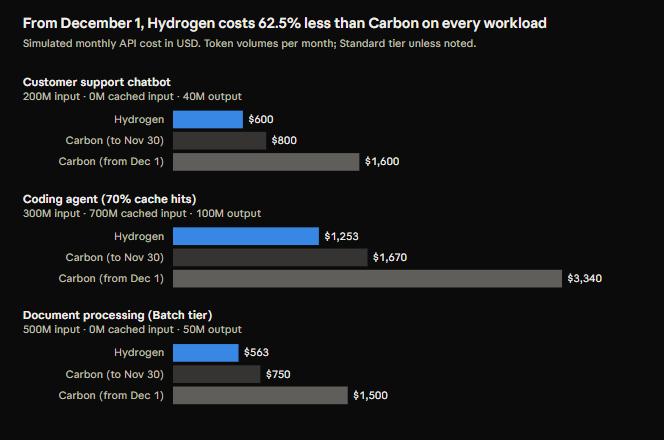
The ratio holds on every workload because Hydrogen's rates are exactly 37.5% of Carbon's December rates. Only the dollar gap changes with volume.
These figures assume both models use the same number of tokens per task. In practice, Carbon often generates more thinking tokens, so its real bill can be higher still. Run a sample of your own traffic through both models to measure the true difference.
Which model is more cost-effective?
Hydrogen is the more cost-effective default for most production traffic. Carbon is worth its premium only when a task fails, or needs many retries, on Hydrogen.
Cost per token isn't the same as cost per task. If Carbon solves a hard bug in one pass and Hydrogen needs three attempts, Carbon can work out cheaper. Measure cost per successful task on your own evaluation set, not cost per token.
| Choose Hydrogen for | Choose Carbon for |
|---|---|
| High-volume chat, support and classification | Multi-step code migrations and architecture work |
| Agent worker and verifier steps | Planning and coordination in multi-agent systems |
| Everyday coding, tool use and multimodal tasks | Root-cause analysis across large codebases |
| Latency-sensitive user-facing features | Dense, high-stakes document analysis |
| Teams that need a free tier for prototyping | Tasks where a single wrong answer is expensive |
The strongest option is often a mix. Route most requests to Hydrogen and send only the hard ones to Carbon. Google's own Orchestrator does this, and reports 24% lower quota use with near-Carbon results. You can apply the same idea across providers with smart model routing.
How to monitor Gemini API spending
You can't manage a model mix you can't see. Once traffic is split across Hydrogen, Carbon and other providers, you need cost data per model, per project and per user.
Start with these steps:
- Tag every request with a project or feature ID, so you know which product area drives cost.
- Track input, output, thinking and cached tokens separately. A rising output share often means a model is reasoning more than expected.
- Set budget caps per project and per day, so a runaway agent loop can't drain a monthly budget overnight.
- Compare cost per successful task across models each month, and move workloads when the numbers change, as they will on December 1.
Centralized tracking makes this much easier than piecing together provider consoles. Opviera records each request's cost before it's billed and ties it to a project and user. Its dashboards show a per-model cost breakdown, including separate cache rates. Teams can also set daily and weekly USD budget caps, and requests that hit a cap are blocked instead of retried silently.
Opviera can also cut the bill itself. Smart model routing sends routine requests to lighter models, and prompt compression reduces input tokens before they reach the provider. See the supported models and plans for details.
Conclusion
From December 1, 2026, Gemini 4 Hydrogen costs 62.5% less than Carbon on every token type. That makes it the sensible default for high-volume and latency-sensitive work. Carbon earns its higher price on hard, long-horizon tasks where it succeeds and cheaper models don't.
The best-value setup for most teams is a routed mix: Hydrogen for the bulk of traffic, Carbon for the hard cases. Track cost per model and per task, so you can see when that balance should shift.
Want to know what a routed setup could save on your own bill? Explore Opviera's AI Savings Calculator. Upload a bill or enter your figures, and get a savings estimate in about three minutes.
Sources
- Introducing Gemini 4 Hydrogen for agentic workflows, Google, November 12, 2026
- Gemini 4 Hydrogen: everyday coding and agentic workflows for developers, Google
- Gemini 4 Carbon is now available, Google, November 10, 2026
- Gemini API pricing, Google AI Studio
- Gemini 4 Hydrogen model page, Google AI Studio
- Gemini 4 Carbon pricing, Apidog
- Gemini 4 Hydrogen: specs, pricing, limits and benchmarks, NHI Mag
- Gemini 4 Hydrogen launch and API pricing, Data Studios
Frequently asked questions
How much does Gemini 4 Hydrogen cost?
Gemini 4 Hydrogen costs $1.50 per million input tokens and $7.50 per million output tokens on the Standard tier. Cached input costs $0.075 per million tokens, and Batch and Flex rates are half the Standard price.
How much does Gemini 4 Carbon cost?
Carbon costs $2 per million input tokens and $10 per million output tokens until November 30, 2026. From December 1, 2026, it costs $4 and $20.
Why is Gemini 4 Carbon's price increasing?
Google launched Carbon at introductory rates, which end on November 30, 2026. From December 1, every Carbon rate doubles, including cached input, Batch, Flex and Priority.
Is Gemini 4 Hydrogen cheaper than Carbon?
Yes. Hydrogen is 25% cheaper than Carbon's introductory rates and 62.5% cheaper than its rates from December 1, 2026. The gap is the same for input, output and cached tokens.
Does Gemini 4 charge for thinking tokens?
Yes. On both Hydrogen and Carbon, thinking tokens are billed at the output rate. Carbon reasons more than other Gemini 4 models, so thinking tokens can make up a larger share of its bill.
Does Gemini 4 Hydrogen have a free tier?
Yes. Hydrogen is available on the Gemini API free tier, with rate limits. Carbon requires a paid tier.
Should I use Hydrogen or Carbon?
Use Hydrogen for high-volume, everyday and latency-sensitive work. Use Carbon for hard, multi-step reasoning tasks where Hydrogen fails or needs many retries. Many teams route between the two.
Written by Chamod S.
See what you could save on your AI bill
Carbon's prices double on December 1. Find out how much smart model routing and prompt compression could cut from your AI API and coding-agent spend. Upload a bill or enter your figures, and get a savings estimate in about three minutes.
Explore Opviera's AI Savings Calculator →
Keep reading
AI Code Review Cost in CI/CD Pipelines
How much does automated AI code review cost? Explore per-PR pricing, CI/CD execution expenses, and practical ways to reduce AI code review spending.
Read article → ComparisonAI Cost Forecasting for Developer Teams
How much should your engineering team budget for AI? Explore AI cost forecasts for 10, 50, and 100 developers, with practical examples and spending controls.
Read article → ComparisonOpviera vs LiteLLM: AI Cost Control Compared
Both enforce budgets in the request path. LiteLLM is free, open source, and yours to run and patch. Opviera is ready to use, for engineers and everyone else. An honest look at which fits your team.
Read article →